
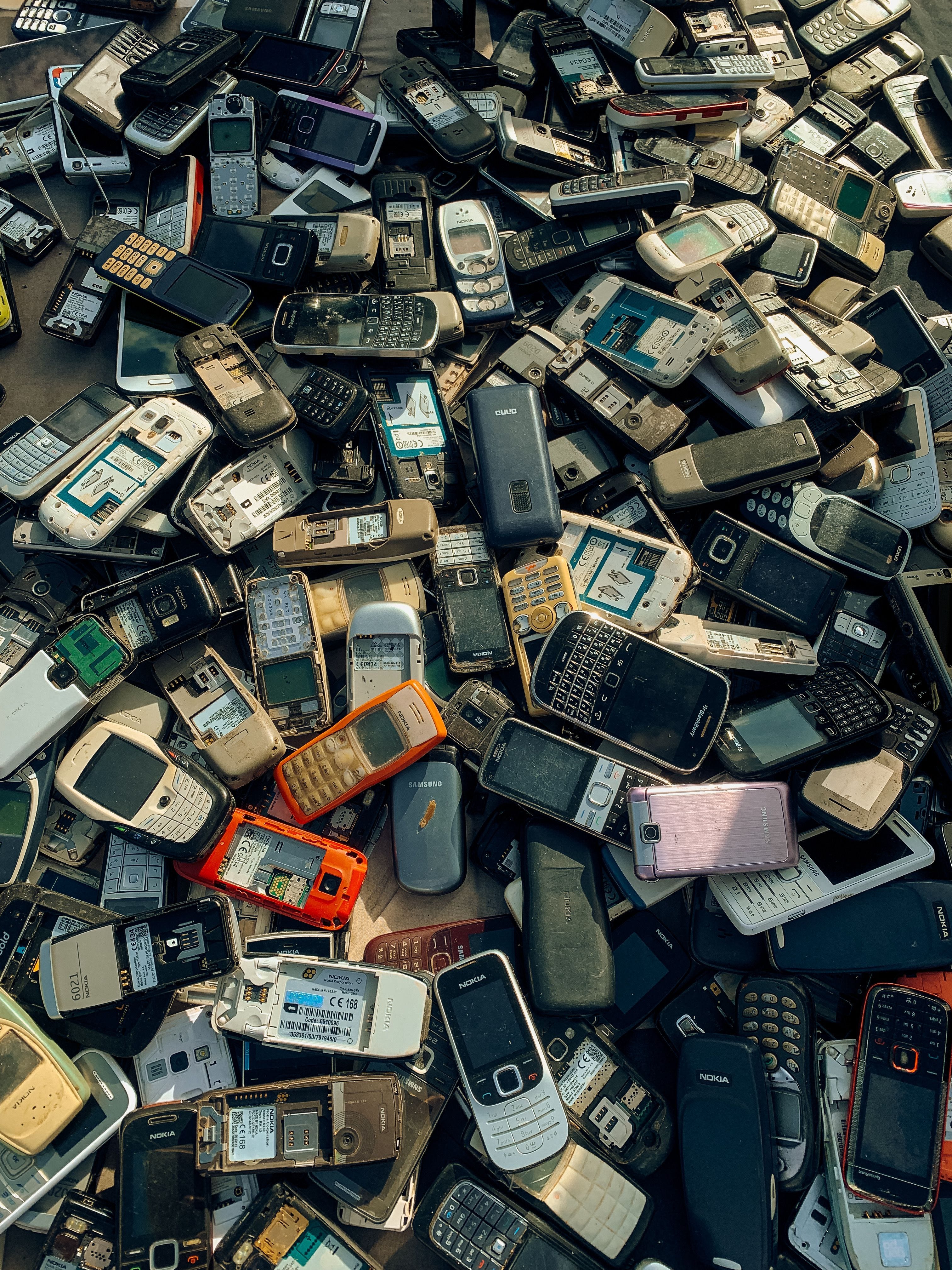
There is a specific fantasy that surfaces every time I document another corner of the ad tech surveillance pipeline (The Silent Enemy): dig the old Razr out of the junk drawer, drop in a SIM, and exit the entire bidstream economy in one afternoon. No apps, no SDKs, no advertising identifier, no real-time bidding auction broadcasting your coordinates to a hundred companies while you check the weather. Just a phone that is a phone.
It is a good fantasy, and it half works. Whether it works for you comes down to two questions that get conflated constantly. Will an old phone still make a call in 2026? And if it does, is it actually quiet? The first is a network engineering question with a brutal answer. The second is a telemetry question with a worse one.
So, as usual, I counted. Behind my Phreak Phone Museum project sits a 68-device dataset covering every notable retro and retro-styled handset from the 1983 DynaTAC to this year’s e-ink minimalists. In July 2026 I ran every record through a 20-agent verification pass against the live web. The census: 48 of the 68 still register with voice service on a major US carrier (a 49th gets a data signal but cannot place a call), 14 survive only overseas, and 5 are dead on every network on Earth. The survivors then split three ways: genuinely minimal stacks, smartphones wearing dumbphone costumes, and one operating system best described as an ad network with a T9 keypad. Which old hardware still runs, and which of it actually escapes ad tech, is the first half of this piece.
The second half is the newest entrant. Commodore, the brand behind the Commodore 64, is back under new ownership and pre-selling the Callback 8020, a flip phone defined by what it refuses to do. It launched June 30, 2026, and by mid-July its US pre-order counter had reached batch 19. The spec sheet, and the caveats the marketing skips, come after the map of what already survives.
The Network Graveyard Made This Market
None of this is driven by nostalgia alone. The dumbphone market of 2026 exists because US carriers spent 2017 through 2026 tearing out every network that older phones speak. Carriers retired 2G and 3G to reclaim spectrum for 4G LTE and 5G, and the FCC’s own consumer guidance is blunt about the consequence: affected phones cannot make or receive calls, including calls to 911 (FCC).
The sequence, for the record:
January 1, 2017: AT&T shuts down 2G GSM
December 31, 2020: Verizon stops certifying CDMA devices, the beginning of the end; the network itself kept running (Verizon)
February 22, 2022: AT&T shuts down 3G UMTS (FCC)
March 31 and June 30, 2022: T-Mobile retires Sprint’s 3G CDMA and legacy LTE networks
July 1, 2022: T-Mobile shuts down its own 3G UMTS
December 31, 2022: Verizon retires CDMA entirely, 2G 1xRTT and 3G EV-DO together (FCC; Verizon)
August 3, 2026: T-Mobile’s 2G GSM, the last legacy network standing, finally dies. Announced for April 2024, delayed repeatedly, and as of this writing still carrying legacy IoT traffic for three more weeks (T-Mobile; TechTimes; TmoNews)
When the dust settled, a phone in the United States needs three things to function as a phone:
An LTE radio on carrier-appropriate bands. For the US majors the load-bearing bands are 2, 4, 5, 12, 13, 17, 66, and 71. Imported devices frequently do LTE, just not on these bands.
VoLTE support. Voice no longer rides a separate 2G or 3G fallback; calls are VoIP over LTE. A phone with LTE data but no VoLTE provisioning cannot place a call, 911 included (FCC).
IMEI whitelisting, in practice. Verizon refuses to activate devices not on its certified list even when the radio is technically compatible, and AT&T’s allowlist quietly rejects working VoLTE hardware: my verification pass found the Nokia 225 4G and 110 4G, the Easyfone Prime-A6, the Balance Phone, and the entire Unihertz Titan line locked out of AT&T despite compatible radios. T-Mobile is the most permissive of the three. The allowlist has quietly killed more dumbphones than any network shutdown.
The practical result is a hardware floor around 2014. In my dataset the oldest devices that still register on a US carrier are the Samsung Galaxy S5 and the iPhone 6, both from that year. Everything older is either a paperweight or an export.
The Survivors: What Still Registers in 2026
The museum dataset tracks each device by year, form factor, radio, carrier compatibility, features, and how chatty the software is. The July verification pass came back with 84 field-level corrections against the live web, and several of them rewrote this section. The corrected census:
48 devices register with voice service on at least one major US carrier today. Every single one of the 48 has VoLTE. That is not a coincidence; it is the entry fee. A 49th, the Boox Palma 2 Pro, registers for data only: it has no VoLTE, so it is a phone-shaped device that cannot make a phone call.
14 devices are alive overseas only. The original Razr V3, the original Nokia 3310, even the 1992 Nokia 1011 (the first mass-produced GSM phone) will still make a real call on the 2G networks that remain live abroad: Germany until around 2028, the UK until around 2029, Mexico indefinitely (Telcel and AT&T Mexico have announced no date), much of Latin America, and nearly all of Africa (Mobile World Live; The Register; BNamericas). Southeast Asia is falling off that list in 2026 itself; Vietnam has already completed its 2G phase-out (Southeast Asia Infrastructure). Same hardware, dead at home, working abroad. The verification pass grew this class from 9 to 14: it turns out the importers’ graveyard holds not just 2G classics but modern 4G hardware with the wrong bands or failed US certification, including the HMD 2660 Flip, the Nokia 8000 4G, the Xiaomi Qin 2, and the Mudita Pure, whose custom antenna failed AT&T and Verizon certification outright.
5 devices are dead everywhere: the AMPS-era Motorola DynaTAC 8000X and IBM Simon, the iDEN Nextel i1000plus, the Sidekick (whose Danger service died long before its radio did), and the Relay Screenless Phone, killed when its companion service shut down in September 2024. Service death, not radio death, is the modern failure mode. The verification pass actually rescued one device from this list: the BlackBerry Bold 9000 turned out to be quad-band 2G GSM under its 3G radio, so it still registers abroad.
The US survivors cluster into distinct classes, and the differences matter more than the marketing suggests:
KaiOS flips (Nokia 2780/2760, TCL Flip 4 5G, Alcatel Go Flip 4, the Tracfone flips): modern radios, WhatsApp, and a limited app store. KaiOS is not a clean room; it is an advertising platform wearing a T9 keypad, and the next section is about exactly that.
Pure feature-OS phones (Nokia 225/110 4G, Sunbeam F1 line, Plum Ram Plus, Orbic Journey V): no app ecosystem at all. The Sunbeam devices, built for Plain communities, omit the browser, the store, and in most variants the camera, by design.
Minimalist and e-ink devices (Light Phone II/III, Mudita Kompakt, Punkt MP02/MC02, Minimal Phone): purpose-built digital minimalism hardware, typically at a price premium. Several of these run stripped Android derivatives under the calm exterior, which matters more than their marketing admits.
Rugged flips running Android underneath (Kyocera Dura line, Sonim XP line, CAT S22, Schok Classic): look like dumbphones, run Android. These carry real telemetry exposure despite having no Play Store.
QWERTY revivals (Unihertz Titan family) and foldable smartphones (Motorola Razr line, Galaxy Z Flip 6), which borrow the form factor but are full smartphones and belong in a different threat model entirely.
There is also a genuine escape hatch for the truly dead hardware: hobbyists run private GSM base stations (Osmocom OpenBSC, YateBTS) inside Faraday cages to light up vintage phones for display and museum use. Legal only if the RF is fully contained, but it means a StarTAC can still ring in 2026 without asking any carrier’s permission.
Even the Dumb Ones Snitch
The verification pass included a telemetry audit of every operating system in the dataset, and the results dismantle the assumption that a keypad means privacy.
KaiOS is an ad network with a phone attached. KaiOS Technologies runs KaiAds, which its own launch materials describe as “the first advertisement SDK and supply-side platform (SSP) designed specifically for smart feature phones,” passing ad requests to buyers through OpenRTB real-time bidding with OS-level access for sub-200ms ad rendering (KaiOS Technologies). The ad SDK is effectively mandatory: KaiOS accepts monetized store apps only if they use KaiAds, and the platform keeps 70 percent of ad revenue (kaios.dev). The privacy policy sanctions collection of IMEI, IMSI, IP address, usage data, and “precise location data, including the real-time geographic location of your device,” shared with “partners and licensees” for, among other things, advertising (KaiOS privacy policy). Google invested $22 million in KaiOS in 2018 specifically to put Assistant, Maps, YouTube, and Search on these devices (TechCrunch; 9to5Google). Ten devices in my census run it.
HMD’s 4G feature phones phone home daily. HMD’s own privacy documentation for data-enabled feature phones lists activation beacons carrying UUID, IMEI, IMSI, and serial number fired at 0, 6, and 24 hours after setup and on every SIM change, plus firmware pings after each boot and daily version telemetry, with no opt-out described (HMD). The data lands on servers in Finland, which is better than most alternatives, but a “dumb” Nokia candybar still announces its identity to its manufacturer every day.
De-Googled Android still pings Google. The AOSP base under the rugged flips connects to Google infrastructure out of the box: connectivity checks, network time, and most sharply A-GPS SUPL requests that can carry the subscriber’s IMSI and serving cell to supl.google.com whenever GPS assistance fires (GrapheneOS; WirelessMoves). A phone with no Google account and no Play Store still tells Google who it is and roughly where it is.
The cheap ones can be actively hostile. A researcher who intercepted the traffic of five sub-$20 white-label button phones with a private 2G base station found four of them malicious out of the box: a premium-SMS trojan, an SMS-interception backdoor used to register fraudulent messaging accounts on victims’ numbers, and vendor firmware posting IMEI, IMSI, and cell tower location to remote servers (Habr, ValdikSS; The Record). The lesson for the AliExpress dumbphone shopper: the OS has no ad stack, but the firmware supply chain is the threat.
The quietest stacks are the purpose-built ones. Sunbeam’s Plain-community flips and the true feature-OS Nokias have essentially nothing to leak with, and Sailfish OS, the base of both the Jolla phones and the Commodore Callback, carries the best documented posture of any platform I reviewed: no ad identifier, no default telemetry, “we do not collect any data without your consent” (Jolla). The honest footnote is that Jolla’s claims are vendor-asserted; nobody has published an independent packet-capture audit, which is exactly the test the Callback should face when it ships.
The verification scoreboard says be skeptical by default. Across the whole privacy-phone market, exactly one de-Googled OS has passed an independent packet-capture audit: /e/OS, the fork sold on Murena phones, which a Trinity College Dublin and University of Edinburgh study found sends no data to Google or third parties, the only OS of six Android variants tested with that result; the same study measured Google Play Services uploading at least 10 times more data than the handset maker’s own OS on every other phone (Leith, Android Mobile OS Snooping). The cautionary tales run the other way: the Freedom Phone, sold as an anti-surveillance device, turned out to be a rebadged $119 Umidigi A9 Pro from AliExpress (Daily Dot; XDA Developers), and GrapheneOS publicly called Erik Prince’s UP Phone a “clear-cut scam,” citing roughly a year of missing security patches (GrapheneOS; How-To Geek). Loud privacy marketing correlates poorly with clean traffic. The only proof that generalizes is a packet capture.
The Comeback, Quantified
The demand side is real and measurable. Feature phones were roughly 15 percent of global handset sales last year, near 210 million devices, though only about 1.7 million of those sold in North America (CNN). The Light Phone III sells for $699, and its co-founder says half of the company’s customers now use it as their primary device, up from a product originally pitched as a weekend secondary phone (CNN). Gen Z is the demographic engine, with flip-phone revival content pulling tens of millions of views on TikTok (The Conversation; Trend Hunter).
The shape of the demand matters more than the headline number. The mass-market button phone is actually shrinking: US feature phone sales fell 38 percent between 2023 and 2024, and Western Europe dropped 11 percent (Counterpoint via press). What grows is the deliberate niche: Counterpoint attributes the US resurgence squarely to Gen Z and millennial digital-detox demand, roughly 28 percent of US Gen Z respondents told Morning Consult they were interested in buying a dumbphone (the highest of any generation), Light has shipped over 100,000 devices, and the research literature now treats “designer dumbphones” as a distinct engineered product category (Counterpoint; CNN). Even the incumbents are hedging: HMD shipped a Detox Mode on its Android Skyline that blocks 14 app categories on a timer, though The Register’s hands-on found the blocked social networks remained reachable through the browser, which makes it a distraction limiter rather than anything ad tech needs to worry about (The Register).
Regulation is the tailwind nobody prices in. Australia’s under-16 social media ban took force December 10, 2025, and enforcement is tightening: regulators found roughly 70 percent of under-16s with accounts still active three months in, and Australia moved to double maximum fines to AU$99 million (Al Jazeera). The UK followed on June 15, 2026, announcing that TikTok, Instagram, Snapchat, YouTube, Facebook, and X will be barred from serving under-16s, with the ban in force by Spring 2027 (GOV.UK). Keep those two regimes in mind for the Callback section below: the app list Commodore blocks at the operating system level mirrors them exactly. It is compliant-by-construction hardware for a market that legislation is about to create.
The health research gives the trend a spine. A randomized controlled trial published in PNAS Nexus in February 2025 blocked mobile internet on participants’ smartphones for two weeks and measured improved sustained attention, mental health, and subjective well-being, with 91 percent of participants improving on at least one outcome (PNAS Nexus; Medical Xpress; News-Medical). Commodore cites that exact study in its own FAQ (Commodore store).
Callback 8020, Read as a Spec Sheet
Commodore opened pre-orders on June 30, 2026 for a phone defined by what it refuses to do: no web browser, no social media apps, no Google services, no advertising identifier, no RCS, no NFC, and no 5G (PR Newswire; Tom’s Hardware; GSMArena).
Two weeks later, on July 14, the US order counter on Commodore’s store sat at Batch 19, with 409 of 500 units remaining and the first batch estimated to ship September to October (Commodore store). Commodore does not publish the size of earlier batches, so treat this as an estimate, but if they held anywhere near the current 500, that is on the order of 9,000 phones pre-sold in 14 days, at $399 and up, for a flip phone whose headline feature is subtraction. That counter is the sharpest data point yet for the market the previous section quantified: phones the mobile advertising economy structurally cannot monetize are selling out in batches.
Strip the nostalgia branding and the Callback 8020 is a technically interesting object. It is not an Android phone. It runs Sailfish OS, a de-Googled Linux-based operating system, with Android apps executing inside a sandboxed AppSupport environment that Commodore claims covers over 99 percent of apps (GSMArena; Android Central; Commodore store).
The blocking is the product. All web browsers and a fixed list of social apps are blocked at the system level using what Commodore describes as patent-pending tech, and the blocks cannot be turned off (Commodore store). The blocked list tracks the apps named in Australia’s under-16 restrictions: Facebook, Instagram, Snapchat, Threads, TikTok, X, YouTube, Reddit, Kick, and Twitch, with Discord, Roblox, and Tumblr added “by popular demand” (Commodore store). Everything else can be sideloaded from APK files.
From the ad tech side, the interesting engineering decisions are the refusals, each of which closes a specific tracking surface:
No Google Play Services means no Google Advertising ID, the primary join key of the mobile ad economy (Android Central).
No browsers at all means no cookies, no fingerprinting surface, no real-time ad auctions. Commodore’s FAQ is explicit that the browser is blocked because it is “the back door” to everything else (Commodore store).
No RCS, because RCS routes messages through Google’s servers; SMS, MMS, and WhatsApp are the supported paths (Commodore store).
No NFC and no big-tech payment apps, which severs the purchase graph. Their FAQ names the reason: financial apps “that insist on running your banking information and personal data through big tech company servers, who know what you bought at midnight last Tuesday” (Commodore store).
No AI by default, on both the OS and the preload list (Commodore store).
The hardware itself is a competent mid-range feature phone: MediaTek Helio G81, 4GB RAM, 64GB storage plus microSD, a 48MP Sony camera, a 1550mAh quick-swap removable battery, dual physical SIM slots with no eSIM, FM radio, IP44 splash resistance, and a touchscreen that ships disabled by default in favor of the keypad (GSMArena; Commodore store). It is 4G VoLTE only, no 5G, which Commodore frames as a battery and attention decision (Commodore store). Press coverage at announcement quoted $499; the store page now lists it from $399 before tax, in five retro colorways (Tom’s Hardware; Commodore store).
What the Blocking Can’t Fix
A technical reading requires the counterweights, because “dumbphone” and “private” are not synonyms:
The baseband still talks to towers. Carrier-side location (which tower, when, moving where) is a property of cellular service itself. No handset design removes it.
WhatsApp ships preinstalled. Content is end-to-end encrypted, but WhatsApp is Meta, and metadata is metadata.
KaiOS is not a quiet OS. Ten devices in my census run an operating system with a built-in real-time-bidding ad platform and a privacy policy that sanctions IMEI, IMSI, and precise-location collection, detailed above.
Twenty-nine of the 68 devices run a full smartphone OS under the hood. The verification pass tore up my original labels: beyond the rugged Kyocera, Sonim, Schok, and CAT flips, it caught Android inside the Punkt MP02 and MC02, the Mudita Kompakt, the Minimal Phone, the Balance Phone, the Wisephone II, the Duoqin and Qin pocket phones, and every kid-monitoring phone in the set. One distinction matters: some of these are privacy-engineered Android derivatives (Punkt’s Apostrophy OS is GrapheneOS-derived), where the label flags lineage rather than observed leakage. The Orbic Journey V went the other way: it turned out to run a proprietary feature-phone OS, not Android, and got downgraded to minimal.
A whitelist store is still a gatekeeper. Commostore approval, however benevolent, is a single company deciding what runs, enforced by closed patent-pending code.
It is not the Commodore you remember, corporately. The original Commodore International died in the 1994 bankruptcy. The trademarks passed through a chain of owners until July 31, 2025, when a new Delaware company led by retro-computing YouTuber Christian “Peri Fractic” Simpson completed the purchase of Commodore Corporation B.V. and its 47 surviving trademarks for a low seven-figure sum (The Escapist; Time Extension). An Italian firm, Commodore Industries, still contests parts of the branding (The Escapist; Time Extension). The privacy promises are only as durable as a one-year-old company’s ownership of them.
It does not exist yet. As of June 2026 Commodore has booting pre-production samples, with compliance testing as the self-declared long pole, and Q4 2026 as the shipping target (Commodore store; GSMArena). Every claim above is a design commitment, not a shipped fact.
The dumbphone comeback is real, it is measurable, and for the first time since the smartphone consolidated the market, hardware vendors are competing on how little data leaves the device. The section below contains the raw data: the full 68-device census with status, radios, carriers, and tracking labels, the Callback 8020’s complete band list and spec sheet, and the pre-order telemetry as observed.
