
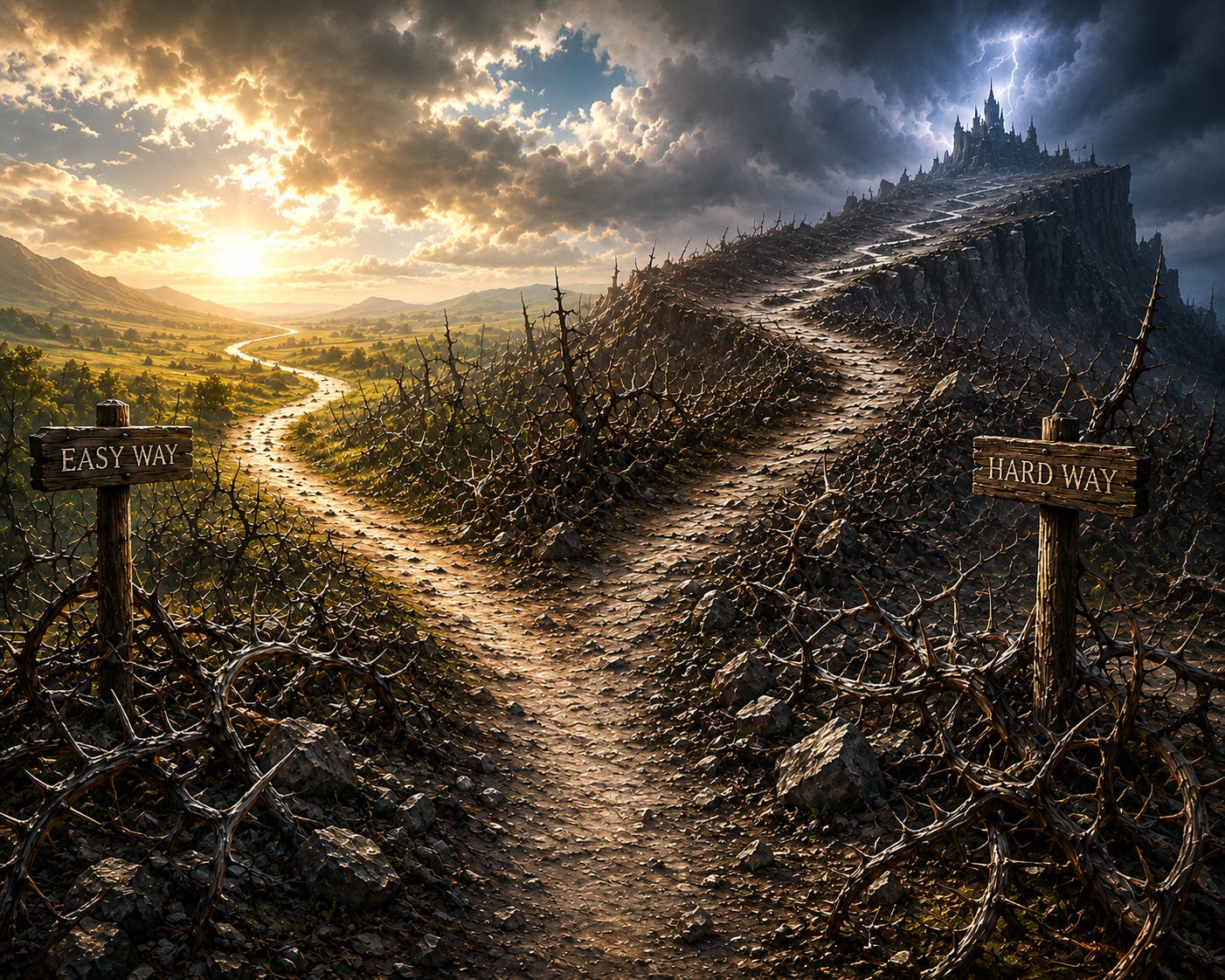
“It’s a dangerous business, Frodo, going out your door. You step onto the road, and if you don’t keep your feet, there’s no knowing where you might be swept off to.”
Words never spoken so true.
The Door Is Already Open
Life is a storm. You will stand in the sunlight one morning and be drenched to the bone by nightfall, and no forecast will have warned you. This is not a flaw in the design. This is the design. The world was never a safe place dressed up in danger. It was always a dangerous place dressed up in the illusion of safety, and the illusion holds only as long as you stay indoors.
Step outside. The moment you do, the world will not pause to ask whether you are ready. It will not soften its edges for your comfort or slow its current for your hesitation. It has its own rhythm, ancient and indifferent, and it has been moving long before you arrived and will move long after you are gone.
Your only task is to learn to move with it.
Most of the people you admire did not find a clean road. They did not inherit a map with the hard parts already removed. They walked something altogether different: a thorny path. Overgrown with bramble. Uneven beneath the foot. It snags the skin and slows the stride, and where the ground sinks low it turns brackish, neither solid nor water, neither one thing nor the other, uncomfortable, unromantic, and stubbornly, ferociously real.
The thorny path does not photograph well. You will not see it on anyone’s curated life, behind the glowing screen, in the filtered light of someone else’s performance. That is precisely why you must seek it out.
Submit to the Ebbs and Flows
There is a kind of war that will exhaust you before it ever injures you, and it is the war against what is. The river does not fight the bend in its bed. It does not negotiate with the boulder in its path. It shapes itself around the obstacle with patient, relentless intelligence, and it keeps moving, and it always arrives.
You are the river.
Life is not linear. The sooner you release the need for it to be, the sooner you may direct your energy toward the only thing that has ever mattered: adaptation. The ebbs are not punishments. They are not evidence of your failure or proof of your inadequacy. They are the tide pulling back to gather strength for what comes next.
Submit to the current. Not in defeat, not in resignation, but in the fierce intelligence of a creature that understands the difference between what can be controlled and what cannot. The man who spends his strength resisting the river arrives at the shore exhausted and unchanged. The man who learns to read the current arrives transformed.
Choose the Hard Path on Purpose
Here is the counter-intuitive truth that most people discover far too late, on the wrong side of a comfortable life they do not recognize as a trap: the clean path is the dangerous one.
Comfort is a magnificent liar. It tells you that you are safe when you are only still. It tells you that you are content when you are only undisturbed. And it keeps you there, warm and undisturbed, until the day life does what life has always done, which is change without your permission. And on that day, the comfortable man breaks. Not because the storm was exceptional. Because he was never tested.
The people who cannot be broken are not the people who were spared hardship. They are the people who sought it out. Who chose the harder city and the harder conversation and the harder road before the road was chosen for them. They made friends with discomfort long before discomfort arrived uninvited, and so when it came they recognized it. They had been there before. They knew what they were made of because they had tested it deliberately, and often, and without apology.
Choose the thorny path. Not because suffering is holy. Not because pain is a virtue in itself. But because difficulty is the only teacher who has never once lied to you.
The Fun Is in the Fight
No one tells you this part. The destination is almost always a letdown.
You reach the thing you bled for. You stand in the place you imagined from a great distance, and you stand there for a moment, and then the question rises, quiet and uninvited, from somewhere you cannot locate: is this it?
The answer is yes. And the mercy in that answer is this: the best part is already behind you, already lived, already permanently yours. The nights when you could not see the finish line and kept moving anyway. The morning you wanted to quit and did not, for reasons you could not fully articulate even to yourself. The small, private victories that no one witnessed and no one will ever record. The version of yourself that was forged in those hours, in that fire, in that solitude.
That is the article. The diploma, the title, the number in the account: those are receipts. Proof of purchase. They confirm what happened. They are not what happened.
Fall in love with the process. Let the destination be only the evidence that you endured long enough to reach it.
Everything Is Temporary. Everything.
The suffering you are inside right now, the rejection that stings like an open wound, the failure you are convinced will follow you forever, the version of the story you tell yourself at three in the morning when the room is dark and the doubts are loud: none of it will hold its shape.
This is not sentiment. This is physics. Nothing holds its shape forever. The stone that stands against the river long enough is worn smooth and carried to the sea. The storm that rages hardest exhausts itself first. Pain has a shelf life. Shame fades. The lowest point of your life is not a fixed coordinate. It is a season. And seasons change.
What you do while you are inside the hard part is the only variable under your control. And the people who emerge sharpest from the fire are not the ones who suffered least. They are the ones who looked at the suffering and said: I will let this make me something. Not destroy me. Not define me. Make me.
Treat the hard part as training. Because that is what it is.
Weaponize It
Here is the distinction that separates the weak from the nation builders, and it is a distinction that almost no one will tell you because almost no one has lived it long enough to understand it.
The anger is real. The depression is real. The darkness that descends at the lowest points of the path, where the bramble grows thickest and the ground runs brackish, the kind that sits in your chest like ballast and makes the simplest movement feel like wading through concrete: it is real, and you are not broken for carrying it. What you do with it is the only question that matters.
Most people allow those feelings to be a verdict. They read the anger as proof that something is wrong with them, and they read the depression as evidence that the path was a mistake, and they stop. They turn inward. They go still. And the fire that could have built something instead burns the house down from the inside.
But there is another way to receive it.
Anger is fuel. Depression, at its root, is often grief, and grief means something mattered enough to lose. The darkness you are inside is not a signal to retreat. It is energy that has not yet found its direction. Your job is to give it one.
History’s most formidable builders were not people who were spared the fire. They were people who learned to feed it into the furnace instead of being consumed by it. They took the rejection and built. They took the humiliation and trained. They took the grief and created. They transformed the rawest, most volatile material inside themselves into the force that moved everything else.
This is the weapon. Not the absence of pain. The redirection of it.
When the darkness comes, and it will come, do not ask how to make it stop. Ask what it is trying to build in you. Ask what it is angry enough about to fight for. Ask what it grieves enough to protect. Then take that answer and go to work with it.
The fire that destroys the undisciplined is the same fire that forges the determined. The only variable is the hand that holds it.
This is what the nation builders knew that the crowd never figured out: the fuel was always there. The only question was what you were willing to build with it.
Put Down the Phone. Stop Comparing.
There is a war being waged for your attention, and the primary weapon is not violence or noise. It is comparison. Every feed you scroll is a curated monument to someone else’s finest moments, selected and filtered and timed for maximum impact on your insecurity. You are watching the highlight reel and mistaking it for the full film.
The person you measure yourself against in the quiet hours is not showing you the doubt, the debt, the nights they nearly walked away from everything you envy. They are showing you the version they have chosen to sell. And you are buying it at the cost of your own direction.
Your path is not their path. It cannot be. You do not carry their specific history, their specific wound, their specific gift, their specific timing. To copy their path is to misunderstand the nature of paths entirely. It would be like training for the fight of your life using someone else’s hands.
Lock in on yourself. What do you possess? What do you want? What is the single honest next step? Answer those three questions and let everything else fall away.
The Lone Wolf and the Long Game
There will be stretches of this road where no one around you is walking in the same direction. No one understands the hours. No one recognizes the obsession. No one can see what you see from where you are standing. You will be misunderstood, and then you will be dismissed, and then, if you keep going, you will be called inevitable by the very people who were not watching.
That solitude is not a warning. It is a compass reading.
The lone wolf does not require the approval of the pack to know which direction to run. The hyperfocus that separates you from the crowd in the short run is the same engine that compounds, quietly and without announcement, into something extraordinary over time. Most people cannot sustain their attention long enough to go deep. Depth is the advantage that cannot be stolen from you. Protect it as you would protect anything precious.
The loneliness is not permanent. But the work you do inside it is.
The Old Advice Is Dead
Say this plainly, because it is not being said plainly enough: the advice of the old world does not apply to you anymore.
The people who came before you are not your enemies. Many of them are wise, and their wisdom was hard-won. But wisdom earned in one era does not transfer cleanly to another, and the era you are inheriting is unprecedented in ways that honest people are only beginning to name. The ladders they climbed have been pulled up. The institutions they trusted are showing their seams. The rules they passed down were written for a world that is shifting beneath your feet in real time, and no one, no pundit, no mentor, no algorithm, no one has a clean map of what comes next.
Be suspicious of anyone who tells you otherwise. Be especially suspicious of anyone who speaks on the future with certainty, who packages the unknown into a product, who profits from your confusion by selling you their confidence. The honest response to this moment is not a roadmap. It is a posture. Stay alert. Stay grounded. Stay kind. Stay ready.
That is not nothing. That is everything.
The Principles of Man Are Shifting Sand
Every generation inherits a set of principles that its culture treats as permanent. Most of them are not. They are products of circumstance, of power, of whoever held the most influence at the moment they were inscribed. They feel fixed because you were handed them before you were old enough to question them.
Question them now.
Not because truth does not exist. It does. But because the truth worth building a life on is not crowd-sourced. It is not found in trends, or consensus, or whoever is loudest this week, or whatever framework the powerful find convenient this season. Human principles are subjective. They bend under pressure. They have been revised and weaponized and revised again more times than history has been honest enough to record.
The constants are older than the noise. Be kind. Be loving. Do not harm the innocent. Honor your word. Protect those who cannot protect themselves. These are not new instructions. They have survived every civilization that tried to replace them, because they cannot be replaced. They are load-bearing walls in the house of what it means to be a human being.
Ignore the frameworks that shift with the wind. Follow what has held.
Live by Your Own Code
The world will attempt to write your code for you. It will do so continuously, from the moment you are old enough to absorb language, through every screen and every room and every voice that carries influence. Culture will offer you its values. Your peers will offer you their approval on the condition that you reflect them back. The age you live in will tell you what to want, what to fear, what to be ashamed of, and what to celebrate. It will do all of this without announcing itself, without asking your permission, and without concern for whether the code it installs in you is true.
Refuse it.
Not in bitterness. Not in isolation. But with the quiet, deliberate authority of a person who has already decided what they stand on. You are not raw material for someone else’s vision. You are not a surface to be written on by whoever applies the most pressure. You are a person with a specific soul, a specific calling, and the sovereign right to determine what governs you.
Live by your own code. Let it be yours, earned and chosen, not inherited by default or borrowed to fit in.
And if you are asking what that code should be built on, the answer has already survived every empire that tried to replace it. Structure your code on the tenants of Christ and you will not be led astray. Love your neighbor. Serve the vulnerable. Speak the truth even when it costs you. Forgive without weakness. Hold yourself to a standard higher than what the world requires. These are not soft instructions. They are the most demanding code ever written. Every person who has sincerely attempted to live them has been made larger by the attempt.
The influence of others will shift. Trends will invert. What the crowd rewards today it will punish tomorrow. But the code that has held through two thousand years of human folly is not subject to the news cycle.
Build on what holds. Live by what is yours. Let the rest fall away.
God, Family, and the Homestead
All of this, the path, the fight, the endurance, the growth, it needs an anchor. Without one, you are only accumulating. And accumulation without meaning is its own species of emptiness, its own quiet kind of lost.
Believe in something larger than the outcome. Whether that is faith in God, or commitment to your family, or the sacred obligation to build one: root yourself in what survives the rise and fall of circumstances. When the brackish path gets genuinely dark, and it will, that anchor is the thing that holds when nothing else does.
Build your family. Protect your homestead. Not as a retreat from the world but as a foundation within it. The people closest to you, the ones who depend on you and the ones you depend on, that circle is not a distraction from your purpose. It is the point of your purpose. Whatever is coming, and something is always coming, the people who endure are the ones who prepared a place to stand and filled it with people worth standing for.
The people who last are never only the most talented. They are the ones whose reason was larger than their fear.
Die Before the Battle
The ancient Greeks understood something about fear that most modern frameworks have softened into uselessness. They did not teach their warriors to suppress fear, or to breathe through it, or to reframe it into something more comfortable. They taught them to go further.
Sit with the worst outcome. Do not flinch from it. Do not look away. Take it fully into your mind: the failure, the loss, the humiliation, the complete and total unraveling of everything you are trying to protect. Hold it there until it no longer has the power to surprise you.
This practice, what the Stoics called premeditatio malorum, the premeditation of evils, was so effective as a mental discipline that variations of it have been restricted or outright banned in certain competitive arenas. The reason is simple: a person who has fully conceptualized their own defeat before the contest begins has nothing left to fear from the contest. They have already paid the price in imagination. What remains on the other side of that exercise is not recklessness. It is clarity. Pure, unobstructed clarity.
Fear does not live in the worst outcome. Fear lives in the gap between where you are and the worst outcome. It feeds on the uncertainty of whether the bad thing will happen. Close that gap yourself, deliberately, before the opponent or circumstance does it for you, and the fear collapses. There is nothing left for it to threaten you with.
The warrior who has already died in his mind fights without hesitation. The entrepreneur who has already lost everything on paper signs the papers without trembling. The person who has already sat with their own worst failure and survived the sitting is not reckless. They are free.
This is the mental block that can be superseded. Not by courage alone, not by willpower, not by pretending the danger is not real. By going further into the imagined darkness than fear is willing to follow you. Fear stops at the threshold. Walk through it. What waits on the other side is not emptiness. It is the version of you that cannot be held back by the possibility of loss, because you have already accounted for it, already made peace with it, already decided that even the worst outcome does not change what you owe the path.
Go there first. Then go to battle.
Do Not Be Ashamed. Do Not Be Afraid.
Shame is a tool. Fear is a tool. Both have been wielded against you and will be wielded against you again, to keep you small, to keep you agreeable, to prevent you from becoming the version of yourself that other people would have to reckon with.
Shame says you are not enough. It is lying. You are in process. Every person of consequence was in process once, for longer than they will confess, through more than they will describe in public.
Fear says the worst is certain. It is not. Fear is a biological alarm system calibrated for immediate physical danger, pressed into service for a kind of slow, ambient, modern pressure it was never designed to handle. It fires too often and for the wrong reasons. You may acknowledge it. You may not obey it.
You are allowed to be uncertain and still move. You are allowed to be afraid and still step through the door. You are allowed to not have the full plan and still begin. The paralysis is the only true enemy. Everything else is weather.
You Will Come Out on Top
Not because the world will reward you on schedule. Not because the system is just or the timing will be merciful. You will come out on top because the thorny path builds a version of you that cannot be knocked all the way down.
Every adversity you walk through on purpose deposits something into you that does not show up on a resume and cannot be taken from you. Every discomfort you chose instead of fled is a stone added to the foundation. And foundations do not announce themselves. They simply hold.
Do not wait for the clean path to reveal itself. It will not. Step outside. Choose the harder direction. Submit to what you cannot control. Stay in your lane. Follow what has held. Build your people. Protect your home. Let go of shame. Release the fear.
The path is thorny. That is the point. That is the gift.
Go.
Published in June, Men’s Mental Health Month. This is one man’s philosophy, not a replacement for help, and choosing the hard path has never once meant carrying it alone. If the darkness is more than you can weaponize right now, that is not failure. It is the moment to reach for a hand. In the U.S. you can call or text 988, the Suicide and Crisis Lifeline, any hour of any day, and talk to a real person. Reaching out is not the opposite of strength. It is the bravest version of it.
The school of hard knocks is what built me. Getting it out the mud is what cleansed me. Written for anyone standing at the door.
For Frodo.